
On creativity – automation & technology in the creative process
Creativity has been studied extensively within the Western intellectual tradition, and from far more angles, over a longer period of time, than automation or digital technology. Yet despite this long history, creativity research has often been described as fragmented and inconclusive. One reason is that creativity, as understood in the West, is notoriously difficult to define and even harder to measure.
Western creativity has long been surrounded by myths and mystical interpretations. The idea of the lone genius, the sudden moment of inspiration, or creativity as an almost supernatural gift has made the topic uncomfortable for many researchers — particularly in the sciences. As a result, creativity research was, for a long time, treated as marginal or unreliable. Still, serious attempts have been made to bring structure to the field. Notably, Batey and Furnham (2006) offered a comprehensive and critical review of creativity research through the lens of differential psychology, helping to clarify why earlier approaches produced scattered results.
Cognitive psychologist Robert Weisberg further challenged romanticized views of creativity by emphasizing the role of knowledge and expertise. In his work on creative thinking, he argued that creativity does not emerge from nowhere, but builds on existing knowledge structures. Over time, Western theories of creativity have been developed from many different perspectives: Guilford’s psychometric approach, clinical theories such as those proposed by Eysenck, Gestalt psychology, traditional associationist models, evolutionary and Darwinian perspectives, social-psychological approaches, investment theories, and modern cognitive science. Each of these frameworks reflects a distinctly Western attempt to isolate, define, and measure creativity.
Framing creativity in the Western tradition
To investigate creativity meaningfully, Western researchers have emphasized the importance of establishing clear conceptual frameworks. As early as 1953, Stein argued that it is “necessary to distinguish between internal and external frames of reference.” This distinction — between what happens inside the individual and what exists in the external world — is characteristic of Western dualistic thinking. It allows researchers to categorize, compare, and evaluate creative theories more systematically, but it also reveals an underlying assumption: that creativity originates within the individual and is expressed outward.
Later work by Kaufman and Sternberg reinforced this framing, showing how different theoretical perspectives define the scope, nature, and limitations of creativity research. These distinctions are not merely academic. They directly inform how creativity is structured in design processes, innovation models, and organizational workflows within Western contexts.
The “Ps” of creativity
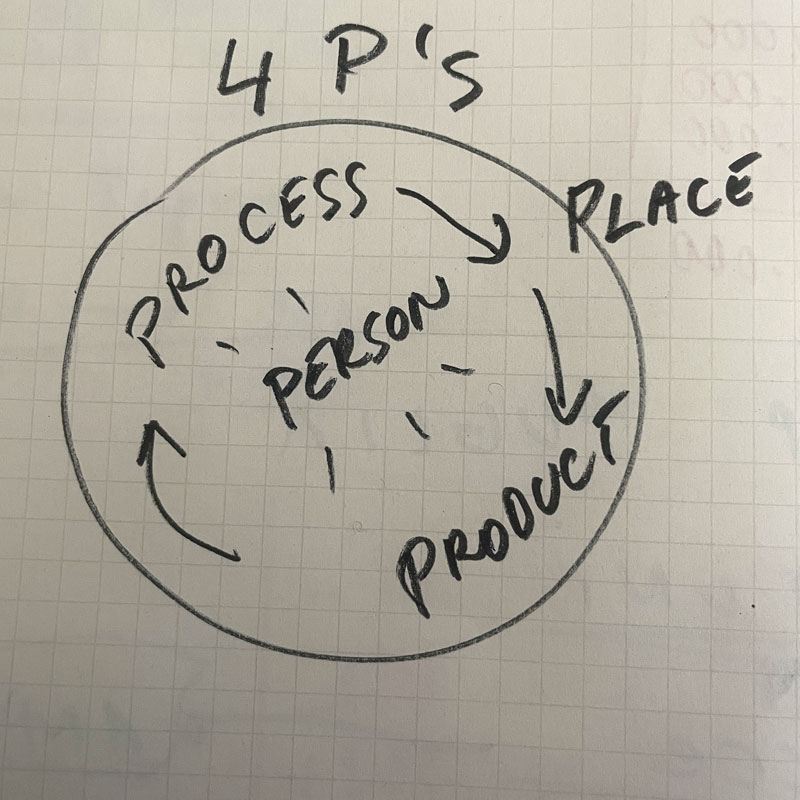
Another influential Western framework looks at creativity through the lens of what aspect is being emphasized. Traditionally, this has been captured by the well-known four Ps of creativity:
-
Process – how creativity unfolds
-
Product – what is created
-
Person – who creates
-
Place (or Press) – the environment in which creativity occurs
More recent Western models have expanded this framework. Runco proposed additional dimensions such as potential, while Simonton introduced persuasion, acknowledging the role of social validation in creative success. Together, these models reflect a Western tendency to deconstruct creativity into components that can be studied, optimized, and applied.
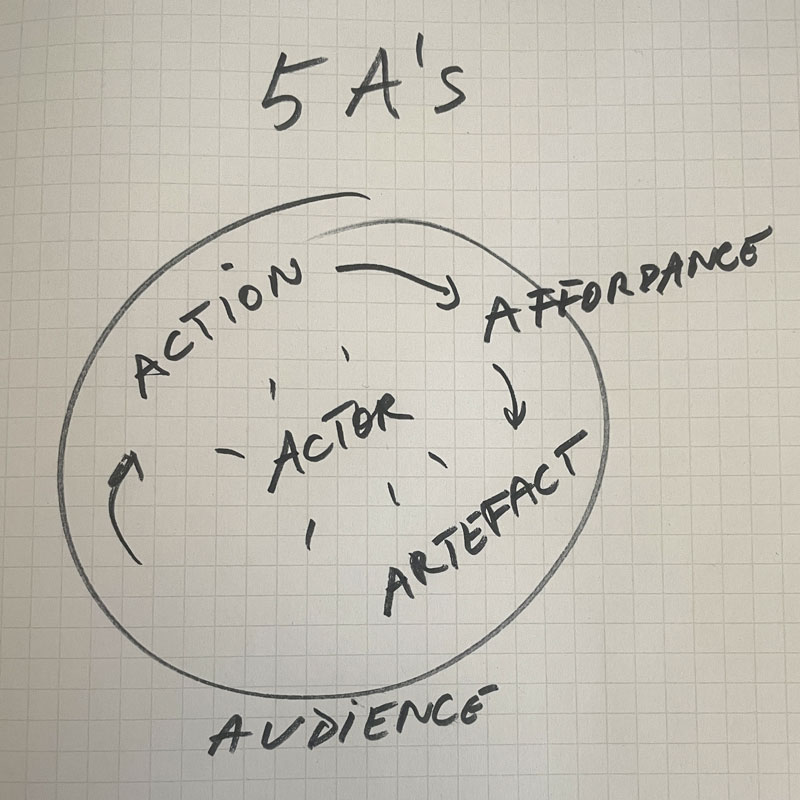
An alternative but still Western-informed framework is Glăveanu’s 5 A model: Actor, Action, Artifact, Audience, and Affordance. This approach shifts attention toward interaction and context and aligns closely with actor-network theory. While it opens the door to more relational thinking, it still operates within an analytical tradition that seeks to map and categorize creative activity.
Creativity as a process and as a skill
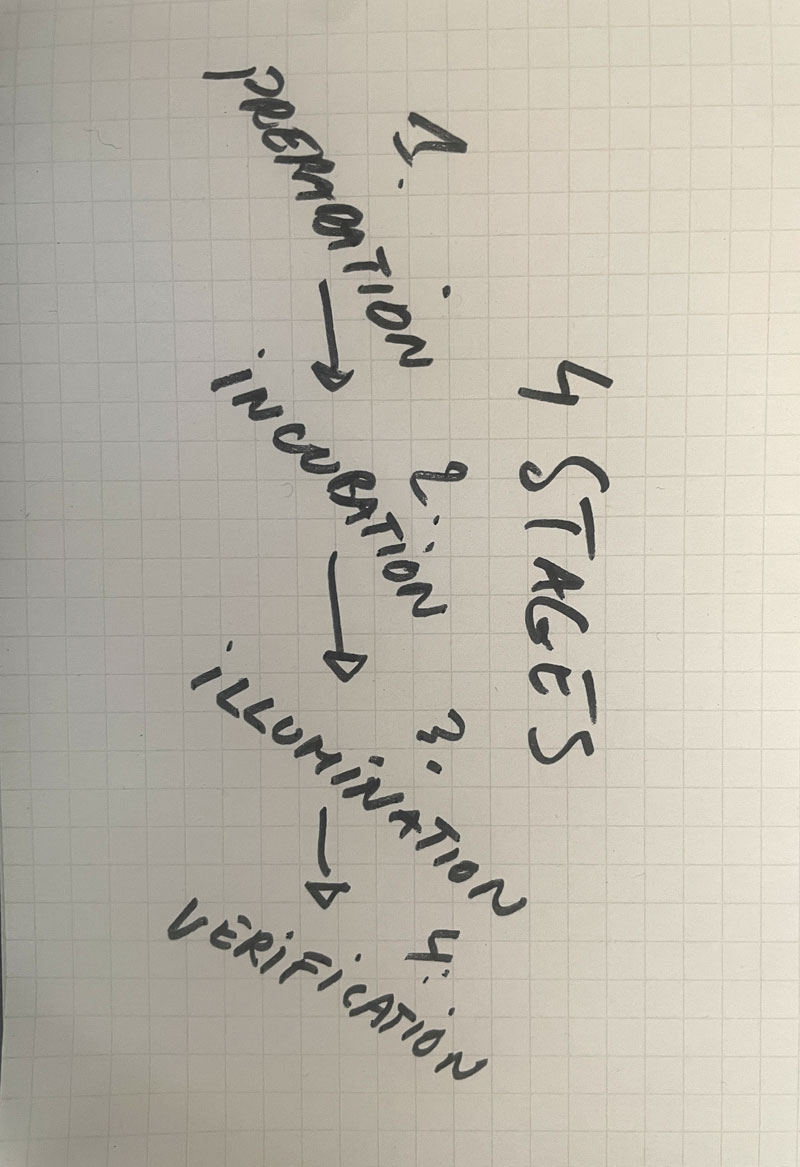
Many Western theories conceptualize creativity as a process unfolding over time. Early models, such as Wallas’s four stages — preparation, incubation, illumination, and verification — continue to influence how creative work is described and taught. These models suggest that creativity progresses through identifiable phases, reinforcing the idea that it can be systematized.
More recent models refined this approach. Mihaly Csikszentmihalyi’s five-step model retains the structured progression but emphasizes insight, evaluation, and elaboration. Other frameworks replace stages with components, shifting the focus from sequence to capability.
One of the most practically influential models in Western creativity research is Teresa Amabile’s componential theory of creativity. Rather than focusing on moments of inspiration, Amabile identifies what is required for creativity to occur: domain-relevant skills, creativity-relevant skills, and task motivation. This model is particularly relevant for design and organizational contexts, as it reframes creativity as something that can be supported, developed, and intentionally designed for.
Cultural boundaries of Western creativity
Although it is rarely stated explicitly, it is important to acknowledge that the theories discussed here are rooted in a Western worldview. This worldview emphasizes individuality, autonomy, authorship, and control over the environment. These assumptions shape not only how creativity is defined, but also how it is practiced, rewarded, and institutionalized.
Eastern creative traditions often follow fundamentally different principles, placing greater emphasis on context, continuity, and collective harmony. These differences matter, especially when creativity intersects with technology and automation. Research using Geert Hofstede’s cultural dimensions has shown that cultural background can significantly influence how people interact with automated systems, including differences in trust, control, and responsibility.
Understanding these cultural boundaries helps clarify the scope and limitations of Western creativity models. They are powerful within their context, but they are not universal.
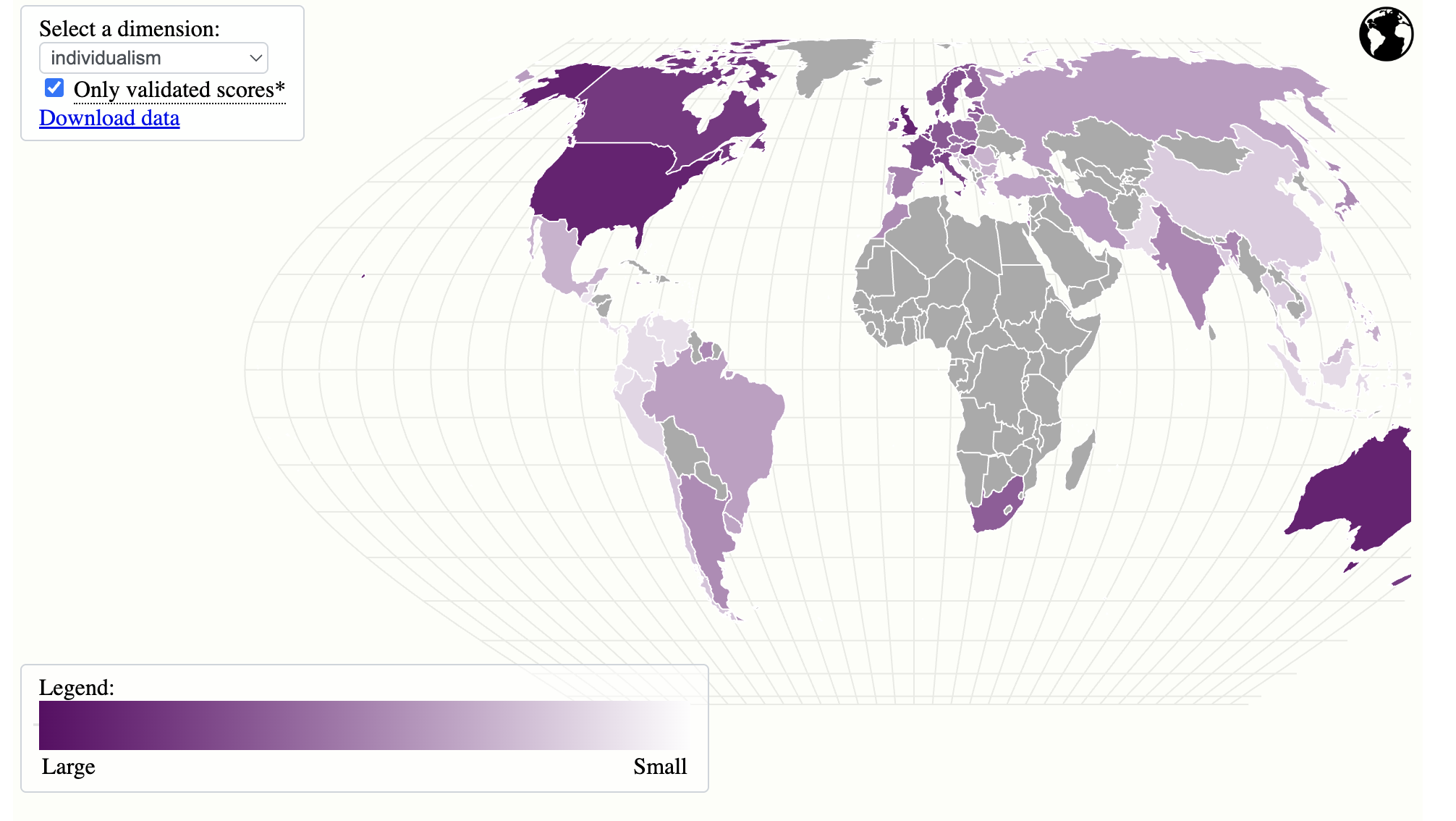
Eastern cultures emphasize control by the environment (i.e.,conformity, harmony, etc.), whereas Western cultures focus more on autonomy and the individual (Ng, 2001).
The myth of originality
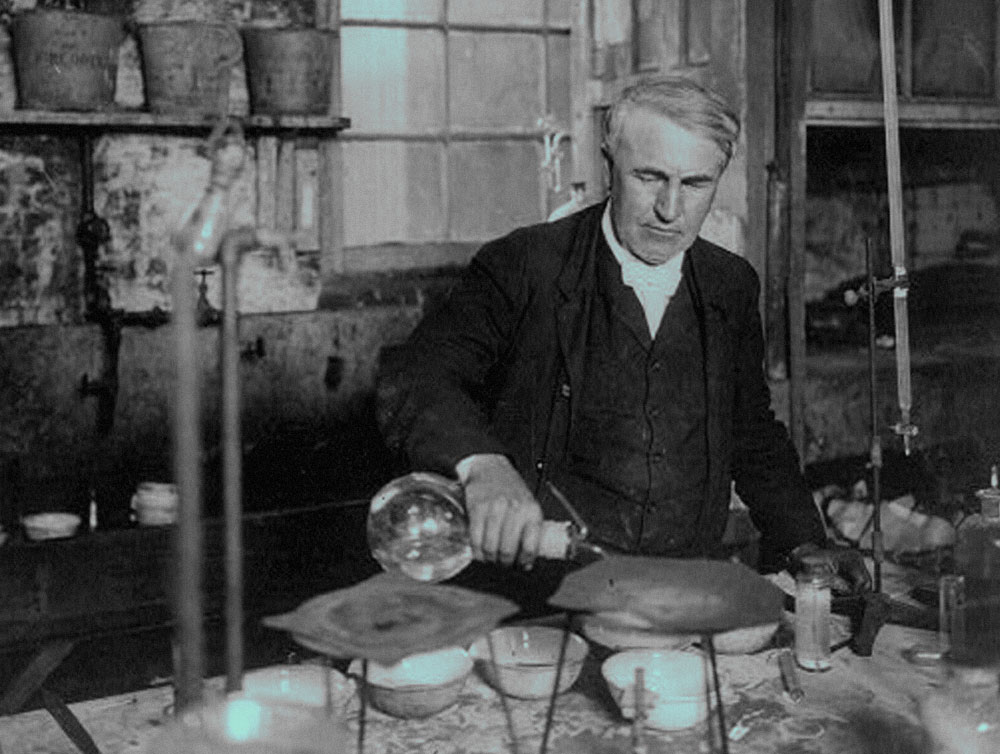
Within the Western creative tradition, creativity is often framed as the act of producing something entirely new — a break from what came before, authored by an individual genius. This belief in originality as creation ex nihilo has shaped how we evaluate creative work, reward authorship, and construct creative myths. Yet much of the Western research discussed here quietly contradicts that idea. Theories grounded in knowledge, process, skill, and context reveal that creativity rarely emerges from nothing. It is cumulative, relational, and deeply dependent on existing structures — cultural, cognitive, and material. What we call “originality” is more often a recombination of known elements within a new frame, rather than a radical invention without precedent.
1879. Edison’s contribution to the lightbulb is often framed as a moment of singular genius, but it was actually an act of recombination, iteration, and optimization.
Toward a broader perspective
The Western creative process has shaped modern design, innovation, and technological development in profound ways. Its emphasis on structure, systems, and measurable outcomes aligns naturally with contemporary tools and workflows. However, as creativity increasingly intersects with automation and AI, the assumptions underlying these models become more visible — and more contestable.
Recognizing Western creativity as one tradition among others opens the door to alternative ways of thinking about creation, process, and meaning. It also prepares the ground for exploring how different cultural perspectives on creativity can inform the design of future creative systems.
References
- KaufmanJ. C., &Sternberg R. J. (2010). The Cambridge handbook of creativity. (pp 23-24) Cambridge University Press
- Wallas, G. (1926). The art of thought. New York: Harcourt Brace and World.
- Amabile, T.M. (2012). Componential Theory of Creativity. Harvard Business School
- Cultural Dimensions by Geert Hofstede https://geert-hofstede.com/countries.html