
On challenging our Western mindset – automation & digital technology
One of the biggest differences between the Western and Eastern worldview is the nature of the reality we perceive. In the Western worldview, we are essentially dualistic. We see the world in terms of duality. We see the world as being composed of subject and object, mind and body, creator and creation. In the duality of the creator and creation, we see the creator as being dominant.
On the other hand, Eastern thinking is non-dualistic. The world is considered a complete and integrated whole, an all-encompassing harmonious system in which everything co-exists. Furthermore, creation is not seen as coming from an individual, but from the continuous interaction between the individual and the environment, culture, and time. This thinking has a significant impact on the practice and understanding of creativity in Chinese culture.
Chinese ways of creating
Confucius can be regarded as the founder of Chinese culture, although he himself believed that he had invented nothing. His aim was not to invent anything new, but to bring back harmony into society by reconnecting people with the principles that once existed in a mythical golden age. Confucius was born in a fragmented society and was in search of order, civility, and balance.
Interestingly, his banishment was the catalyst for his ideas to reach a wider audience. He was compelled to travel across China, and in the process, he was able to gather ideas from different parts of the country. In addition, he was able to build a community of adherents along the journey. This was an early form of a social knowledge network. Over two thousand years later, Confucianism can be seen to be very much a part of Chinese culture and continues to influence the meaning of creativity today.
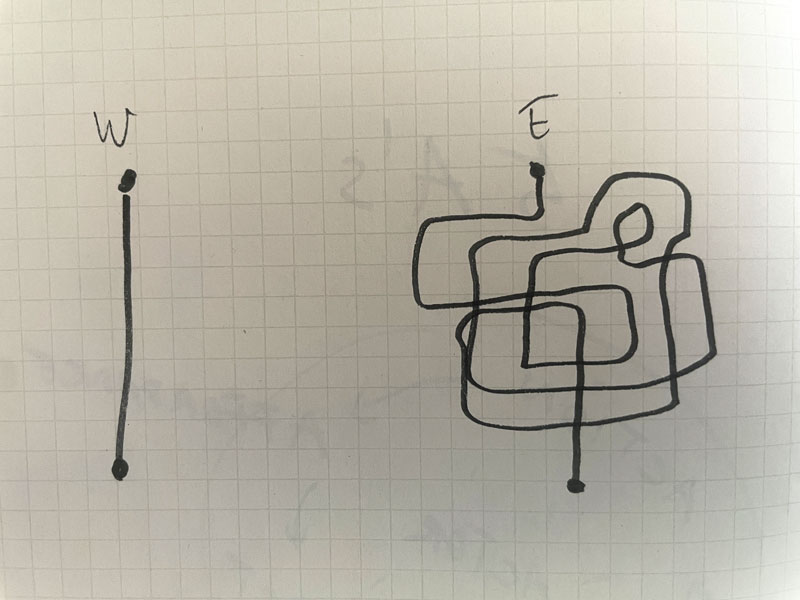
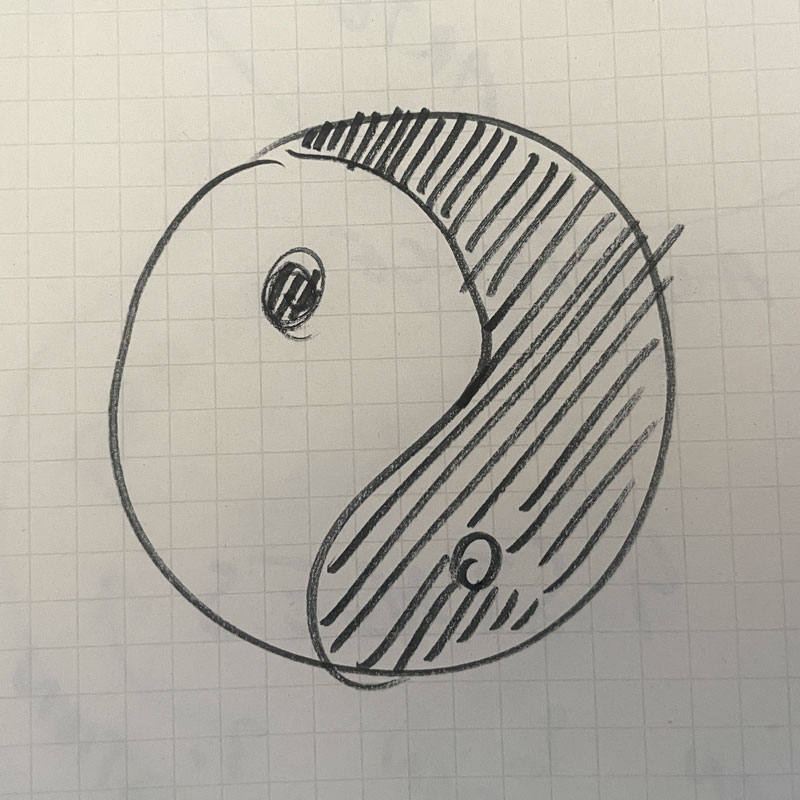
Western philosophy has taught us to think in terms of opposites. However, there are other ways of seeing the world. In Eastern philosophy, opposites are seen as connected parts of a whole.
Creativity as emergence, not invention
In the Chinese view of the world, creativity does not reside within the individual; rather, creativity flows through the world. “The creative process is not so much about relating to a preconceived idea as it is about relating to what emerges.”
It can be likened to drawing without a predetermined end goal in mind. “The drawing evolves based on relationships between the environment, memory, culture, and context. Meaning emerges based on the quality of relationships rather than the end goal of the activity. Creativity in the Chinese context is about creating harmony rather than novelty.”
This could not be more different from the Western concept of creativity, which in the context of design—especially digital design—has become highly outcome-driven and commercially oriented. “The focus of digital design has shifted from the process of getting there to the end product, the final experience, the final result. In fact, in some design processes, much of the process can be reduced to a ‘black box’ with human involvement relegated to the initial stages of ideation and the final stages of quality control.”
The Chinese concept of creativity offers a different perspective: “It’s about embracing the iterative process without a predetermined outcome, so that form and meaning can gradually come together through a process of trial and error, and adaptation. It’s not about stepping back to get distance from the object of our focus; rather, we’re in the midst of the activity itself.”
Culture, craft, and continuous change
This does not imply that creativity in China lacks structure or randomness. Rather, creativity in China is deeply rooted in tradition, craftsmanship, and cultural continuity. The creative individual is surrounded by layers of context, and creativity becomes a dynamic synthesis. The world is full of life, and so is creativity.
The Chinese culture has been characterized by the recognition of constant evolution. Evolution is not a disruption of order; rather, evolution is the order. Creativity in China occurs as an evolutionary process, which is incremental, flexible, and evolutionary. Evolutionary goals provide the direction, and short-term adjustments constantly refine the path.
Western creativity occurs at such a speed and in such a disruptive manner that reality evolves before the intended solution arrives.
What the West can learn
For a long time, the East was considered an “innovative sponge,” soaking up ideas from the West. But now, it seems, the tables are turning. Today, the West is seeking inspiration from the East in areas such as agile methodologies, systems thinking, and long-term strategic planning.
Perhaps the real lesson here is that creativity is not a universal process or a set of universal methods. Creativity is all about perspective. And perspective is all about how we look at the world. By stepping out of our “normal” Western perspective and “wearing a Chinese hat,” so to speak, we can become aware that our perspective is not the only one. And it is precisely this shift in perspective that allows us to create in entirely new ways.