

Dada: when the system broke — and creativity responded
There are moments when browsing an archive feels less like research and more like time travel. The Dadaist publications digitized by the University of Iowa, collected and curated by Timothy Shipe, do exactly that. Leafing through these high-resolution scans is like stepping back into the interbellum — a period suspended between collapse and reconstruction, where certainty had evaporated and new forms were desperately needed.
It’s difficult to overstate how deeply Dada reshaped the creative world we now take for granted. Contemporary art — and much of contemporary culture — simply could not exist without it. Dada wasn’t a style in the traditional sense. It was a reaction. A refusal. A creative system reboot triggered by a world that had stopped making sense.
In response to the devastation of the First World War, the Dadaists dismantled nearly every assumption about what art was supposed to be. They embraced collage and assemblage, chance and randomness, performance and provocation. They collapsed the boundaries between disciplines — literature, music, theater, visual art — and between art and everyday life. Art was no longer something you observed from a distance; it was something that confronted you, interrupted you, sometimes even mocked you.
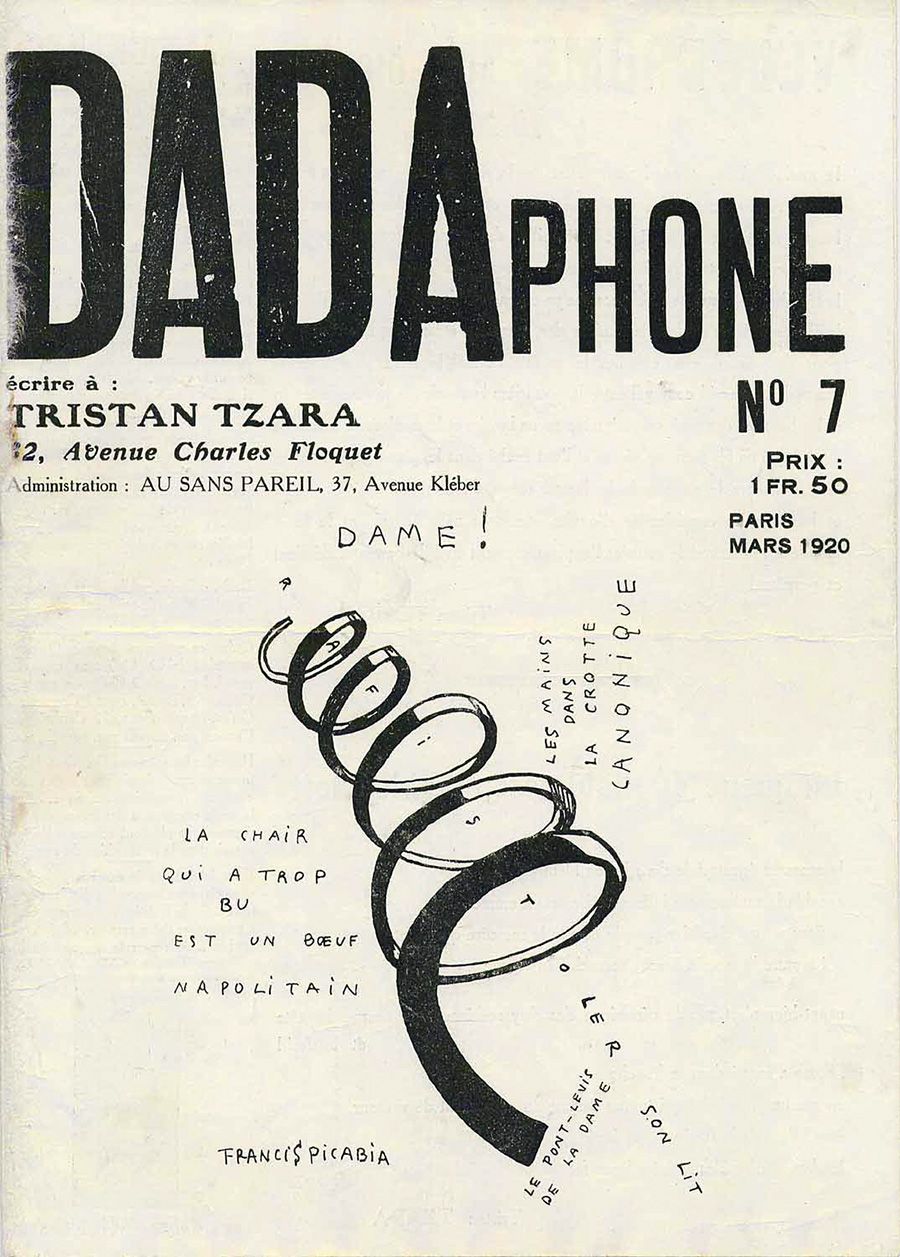
Cover of DADA magazine nr 7, Paris 1920
Anti-art as a new operating system
What makes Dada so relevant today is not its aesthetic, but its logic. Or rather, its deliberate rejection of logic as it was understood at the time. Dada introduced ideas that would later become foundational to modern creative practice: art as process rather than product, authorship as unstable, meaning as something negotiated with the audience rather than imposed.
The movement tapped into sources well outside the Western canon, drawing inspiration from indigenous cultures of Africa, the Americas, and Oceania. It extended abstraction beyond painting into language and film. It treated performance, noise, typography, and found objects as legitimate creative material. In doing so, Dada laid the groundwork for nearly every major artistic movement that followed — from Surrealism and Constructivism to Fluxus, Pop Art, Conceptual Art, and Minimalism.
Looking back, it’s striking how much of what we now call the avant-garde was first articulated — often chaotically — by the Dadaists.
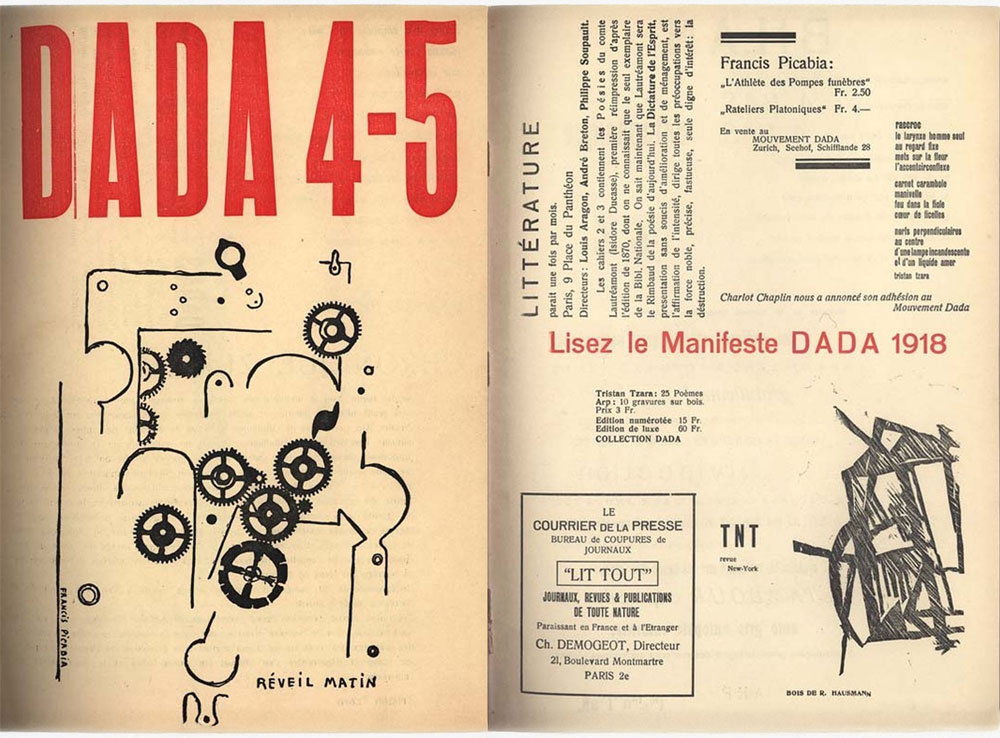
Dada, No. 4-5, (Anthologie Dada) (International Version) Edited by Tristan Tzara Zurich, 15 May 1919
From Zurich cafés to Madison Avenue
Dada’s influence didn’t stop at the gallery door. Its impact spilled directly into public life. The style of political protest that gained prominence in the 1960s — mock trials, guerrilla theater, performative disruption — can be traced back to Dada actions in Zurich, Berlin, and Paris. Dada understood something early on: that spectacle, irony, and confrontation are powerful tools for challenging authority.
Even commercial culture absorbed its lessons. Modern advertising owes a surprising debt to Dadaist experiments with collage and typography. Two members of the Berlin Dada group went on to found a “Dada Advertising Agency,” and Kurt Schwitters’ work in graphic design pioneered visual techniques that are now so normalized we rarely question them.
What began as anti-art became infrastructure.
And commercial advertising as we know it today is indebted to the Dadaists’ experiments with collage and typography; indeed, two members of the Berlin Dada group founded a “Dada Advertising Agency,” and the Hanover Dadaist Kurt Schwitters designed newspaper and magazine advertisements which pioneered techniques which we now take for granted.
-Timothy Shipe
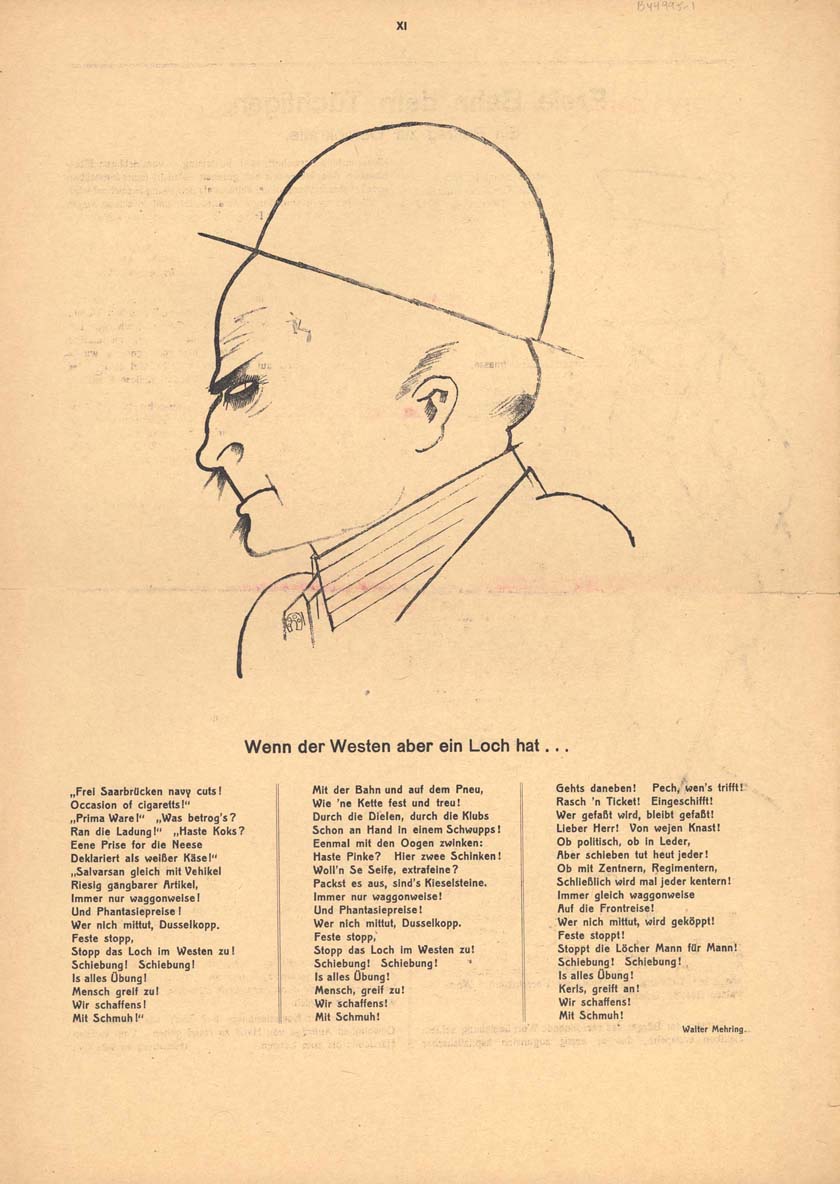
Der blutige Ernst No. 4 (Berlin, November 1919) – George Grosz
Why Dada still matters
Seen from today’s perspective — in an age of automation, AI, and infinite content generation — Dada feels uncannily familiar. It emerged at a moment when existing systems had failed, when language felt hollow and traditional structures no longer held. The response was not refinement, but rupture.
Dada reminds us that creativity is not always about solving problems within a system. Sometimes it’s about questioning the system itself. Breaking it open. Creating space for new forms to emerge.
Browsing those archives today, it’s hard not to feel that Dada was less a historical movement than a recurring condition — one that reappears whenever the world changes faster than our frameworks can keep up.